
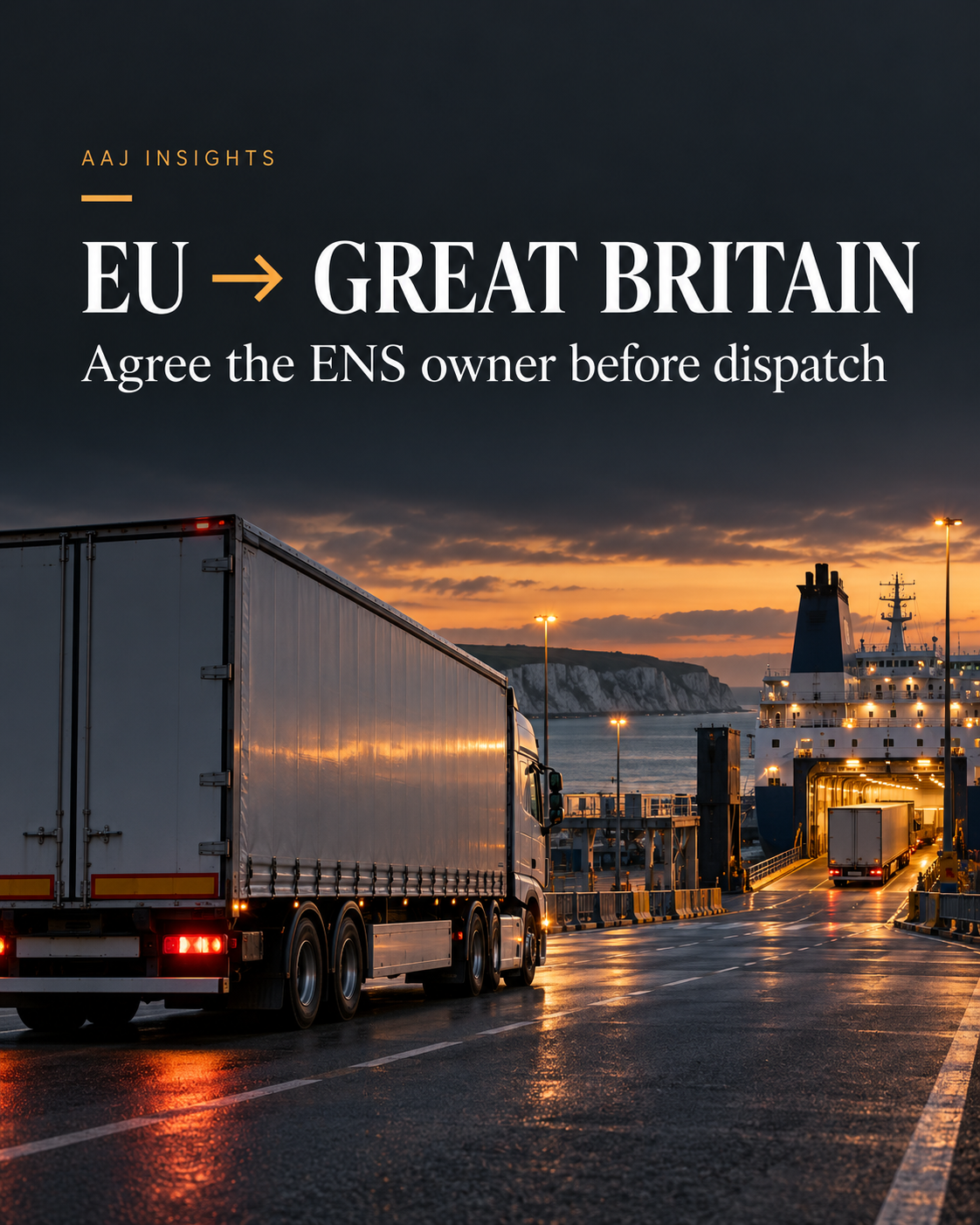
A vehicle booking does not settle every border task. Before an EU-to-Great Britain shipment leaves, the parties should agree who will submit the entry summary declaration (ENS) and who will supply its data. This is a separate handover to plan alongside the cargo, route and delivery window.
An existing requirement, with current guidance
The EU-import safety and security waiver ended on 31 January 2025. HMRC’s ENS guidance was most recently updated on 9 July 2026. This article is an operational reminder, rather than an announcement of a new October deadline.
Great Britain means England, Scotland and Wales. Northern Ireland uses a different safety and security system; a GB checklist should not automatically be applied to an NI movement.
Name the filing party
The carrier must ensure the ENS is submitted. A third party may file under an agreed arrangement. For accompanied RoRo freight and Le Shuttle Freight, HMRC identifies the haulage company as responsible; for unaccompanied RoRo freight, it identifies the ferry operator.
At booking, ask a specific question: ‘Which party is filing this shipment’s ENS, and who is their contact?’ Record the answer in the transport instructions. The practical benefit is a visible handover if the importer, forwarder, agent and carrier are working in different systems.
Check the crossing, then the deadline
HMRC sets the RoRo ENS deadline at least two hours before the ferry’s arrival. For road traffic through the Channel Tunnel, the stated deadline is at least one hour before arrival at the Eurotunnel terminal in Coquelles, France.
Do not use a ferry deadline for a tunnel movement. Build an internal data cut-off that leaves time for the filer to check information and resolve questions. If ENS references are included in GVMS, HMRC says submission must meet the earlier of the applicable minimum deadline or the close of check-in.
Give the filer a usable shipment brief
For GB imports, HMRC identifies S&S GB as the filing service. Its guidance asks for origin, the intended GB arrival location and time, and the sender and recipient. Relevant shipment documents help the filer establish the declaration data.
Send one agreed version of the movement details and identify a contact who can answer queries before dispatch. Ask the filer to confirm that the required information is complete; a transport booking confirmation alone does not establish that an ENS has been accepted.
Keep ENS and GMR checks distinct
HMRC’s GVMS guidance describes how an ENS reference can be associated with a goods movement reference. That association links records; the GMR and the safety and security filing still have different roles.
Use a handover checklist with separate entries for the filing party, ENS submission confirmation, crossing details and any required GMR. If the route or arrival details change, return the change to the filer rather than assuming the original declaration remains accurate.
Takeaway
Before dispatch, confirm the filing party, the crossing-specific deadline and the data handover. Give each task an owner and obtain confirmation that the filing has been handled.
Sources
- HMRC: Making an entry summary declaration — updated 9 July 2026
- HMRC: Customer journey by mode of transport
- HMRC: GVMS safety and security declarations — updated 1 June 2026
Practical reading for this route. Check the official guidance for the circumstances of your shipment.